East Grampian Coastal Partnership
www.stateofthecoast.scot
East Grampian Coastal Partnership
www.stateofthecoast.scot
Marine Planning was introduced by the Marine and Coastal Access Act 2009. It contains high-level objectives set out in the Marine Policy Statement under the act. Marine Planning came about from the need to protect our seas and the marine environment from the conflicting and competing demands of marine activities and development. It establishes a regime for managing our seas sustainably. To ensure that we continue to benefit from our marine environmen, it is essential to seek a balance between the different economic, social and environmental demands on ocean space and to minimise our impact on the marine environment as far as possible. Marine Planning provides the primary means of achieving sustainable marine management in Scotland.
The introduction of the Marine (Scotland) Act 2010 and Marine and Coastal Access Act 2009 (Known as the 'Marine Acts') established a new legislative and management framework for the marine environment, allowing the competing demands on the sea to be managed in a sustainable way across all of Scotland’s seas. Marine planning matters in Scotland’s inshore waters (marine area extending from the coastline out to 12 nautical miles NM) governed by the Marine (Scotland) Act 2010, and by the Marine and Coastal Access Act 2009 for our offshore waters (from 12 to 200 nm). The marine acts created a tiered approach to the development of marine planning in the UK and Scotland. The UK administrations share a common vision of having clean, healthy, safe, productive and biologically diverse oceans and seas. The jointly adopted Marine Policy Statement (2011) provides a consistent high-level policy context for the development of marine plans across the UK to achieve this vision.
It provides a comprehensive overarching framework for all marine activity in our seas. It sets out a policy framework to help determine if a new or existing marine acitivity is environmentally or economically sustainable and suitable for the area and serves as the primary guide to decision-making on the use of marine space and resources in Scotland.
This NMP sets out strategic policies for the sustainable development of Scotland's marine resources out to 200 nm. The current National Marine Plan (2015) sets out the strategic policies for the sustainable development of our marine resources out to 200 nautical miles (nm), covering topics including offshore wind and other marine renewables, aquaculture, aggregates and shipping, ports and harbours.
It provides a comprehensive overarching framework for all marine activity in our seas. It sets out a policy framework to help determine if a new or existing marine acitivity is environmentally or economically sustainable and suitable for the area and serves as the primary guide to decision-making on the use of marine space and resources in Scotland.
This NMP sets out strategic policies for the sustainable development of Scotland's marine resources out to 200 nm. The current National Marine Plan (2015) sets out the strategic policies for the sustainable development of our marine resources out to 200 nautical miles (nm), covering topics including offshore wind and other marine renewables, aquaculture, aggregates and shipping, ports and harbours.
Since the adoption of National Marine Plan (2015) it has been reviewed twice, in line with statutory requirements to monitor and report on: the effects of the plan's policies, the effectiveness of those policies in securing the plan's objectives, its progress in securing its objectives, and other relevant matters. The first review, published in 2018, found the plan to be effective but pointed to EU Exit as one reason that might justify future revisions. The second review, published in 2021, suggested that the urgent need to tackle the twin crises of climate change and biodiversity loss, amongst other factors, had become core drivers for a new plan.
The 2021 review found that there was a clear need to update NMP1 to reflect the significant changes in the wider policy and legislative landscape, rapid developments in technology, the need to deliver a green recovery from COVID-19, as well as to reflect our improved understanding of the marine environment, including the socio-economic benefits of marine development. The review highlighted that the Scottish Government's commitment to delivery of a Blue Economy Approach, to establish and grow "blue" as a natural capital asset in Scotland, would be an important policy development and that the policies in the National Marine Plan would need to reflect and be aligned with the ambitions within the Blue Economy Vision.
The Scottish Government in its new NMP2 gives relevance to the Blue Economy Vision to establish and grow "blue" as a natural capital asset in Scotland.
Blue Economy approach covers:
• Future Fisheries Management Strategy
• Offshore Wind Policy Statement
• Seafood Trade Strategy (forthcoming)
• Aquaculture Vision (forthcoming)
• Wild Salmon Strategy (forthcoming)
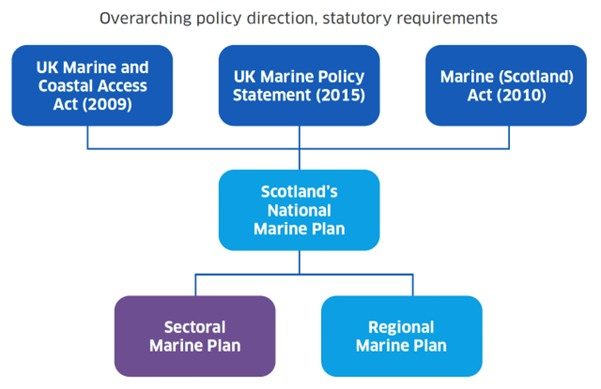
Table 1
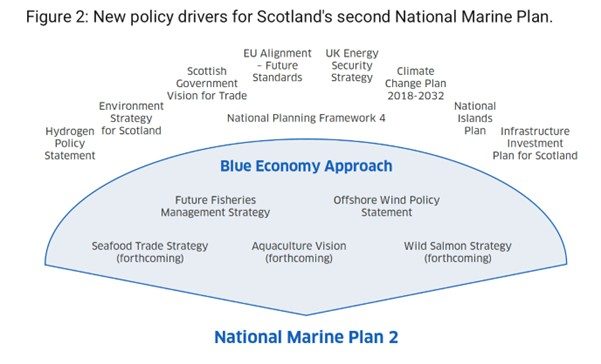
Table 2
09/12/2026 by Shaleen Sharma
12/12/2026 by Ian Hay
Live - Next review due 25/12/2027
To report errors, highlight new data, or discuss alternative interpretations, please complete the form below and we will aim to respond to you within 28 days
Telephone: 07971149117
E-mail: ian.hay@stateofthecoast.scot
We need your consent to load the translations
We use a third-party service to translate the website content that may collect data about your activity. Please review the details in the privacy policy and accept the service to view the translations.