East Grampian Coastal Partnership
www.stateofthecoast.scot
East Grampian Coastal Partnership
www.stateofthecoast.scot
Seafood processing is one of the largest contributors to the food and drink sector in North East Scotland, estimated to be worth in the region of £700 million to the North East out of a total of £2.2 billion of overall food manufacturing turnover. The combination of labour shortages, rising costs, post-Brexit trade barriers, structural infrastructure constraints, and supply-chain risk paints a challenging picture for the north-east Scotland fish-processing industry. Scotland, and particularly the Grampian area, remains a major hub for seafood processing, specifically for pelagic species (mackerel, herring) and mixed-species processing. A survey commissioned by Aberdeenshire Council on behalf of the North East Scotland Fisheries Local Action Group (NESFLAG) in 2020 found that the total number of seafood processing businesses in North East Scotland is 72, with the number of sites amounting to 75 (Figure 1, Table 1).
The fish-processing industry in north-east Scotland faces severe labour shortages, largely because it has historically relied on migrant workers from the EU to fill essential roles in filleting, gutting and handling. After Brexit, stricter immigration rules and higher salary thresholds for Skilled Worker Visas sharply reduced the availability of foreign labour, making recruitment difficult even for well-established firms. Processing plants in rural coastal towns also struggle to attract UK workers due to limited housing, poor transport links and the physically demanding nature of the work (Scottish Government, 2020).
Fish processors in the north-east are under intense pressure from rising operating costs, especially energy, which is critical for running chill stores, blast freezers and processing lines. Energy bills for some firms have doubled or tripled, while packaging, transport and general overhead costs have also climbed steeply. These cost increases are especially damaging for small and medium-sized processors, which often operate on narrow margins and lack the capital needed to invest in more efficient equipment or modern facilities (NESFLAG, 2020). The Scottish Government notes that many processors face financial barriers to upgrading buildings or reducing energy consumption, increasing vulnerability across the sector (Scottish Government, 2020).
Post-Brexit trading arrangements have created significant barriers for fish processors in North East Scotland, who depend heavily on fast, easy access to EU markets. New requirements for export health certificates, customs paperwork, and catch documentation have added delays and administrative burdens that are particularly damaging for highly perishable seafood products (United Kingdom Food Security Report, 2024).
Finally, the fish-processing sector is deeply affected by fluctuations in local fish landings, which are influenced by quotas, stock status, and seasonal variation. Because processors depend on a steady supply of raw material, irregular landings create uncertainty and make it difficult to plan staffing, production, or investment. Research from Aberdeenshire Council notes that the pelagic and whitefish supply chains are particularly vulnerable, if even one major processor scales back or closes, Scotland’s overall capacity to handle landings could be significantly reduced (Aberdeenshire Council, 2020).
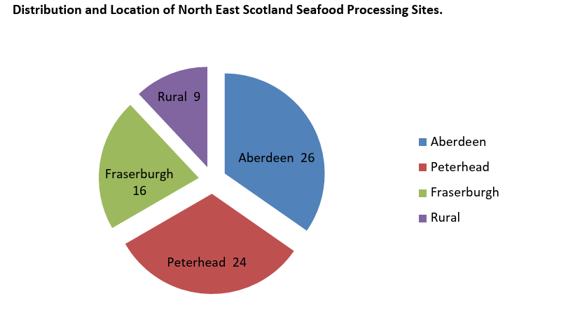
Figure 1: Distribution and Location of North East Scotland Seafood Processing Sites, Final Seafish Processing Report 2024
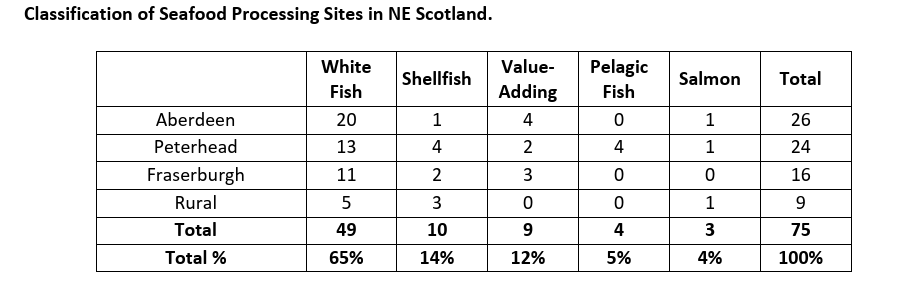
Table 1: Classification of Seafood Processing Sites in NE Scotland, Final Seafish Processing Report 2024
Scottish Government(2020) Constraints and challenges for marine sectors
GOV.UK. (2024). United Kingdom Food Security Report 2024: Theme 3: Food Supply Chain Resilience
Seafish (2024) Issue Seafood Processing Industry Performance 2024
Scottish Government (2024) Our marine sector in an independent Scotland
Live - Next review due 15/01/2027
To report errors, highlight new data, or discuss alternative interpretations, please complete the form below and we will aim to respond to you within 28 days
Telephone: 07971149117
E-mail: ian.hay@stateofthecoast.scot
We need your consent to load the translations
We use a third-party service to translate the website content that may collect data about your activity. Please review the details in the privacy policy and accept the service to view the translations.