East Grampian Coastal Partnership
www.stateofthecoast.scot
East Grampian Coastal Partnership
www.stateofthecoast.scot
The EU Common Fisheries Policy, and now the UK Fisheries Act 2020, aims to eliminate discarding of fish at sea through policies such as the Landing Obligation, where all quota-managed fish caught must be brought to shore. The Landing Obligation is being introduced through the European regionalisation process, where Member States in each sea basin (Baltic Sea, North Sea, North Western Waters, South Western Waters, and Mediterranean Sea) collaborate to develop jointly agreed discard plans. Scotland, as part of the UK, has participated in creating discard plans for the North Sea and North Western Waters, with Scottish representatives attending all relevant meetings. The discard ban has been gradually phased in, beginning in 2015 for pelagic fisheries, extending to demersal fisheries in 2016, and reaching full implementation for all TAC species by 2019.
The Landing Obligation can lead to a situation known as “choking,” where vessels must halt fishing once the most restrictive quota is reached, causing the fishery to close earlier than intended. Choke species issues arise when a fishing vessel catches its entire, usually small, quota for one species that is part of a mixed fishery, forcing the vessel to stop fishing for all other species even if it has remaining quota for them. In the NE of Scotland, primary choke species include hake, saithe, cod, and whiting.
Table 1 illustrates Scottish Producer Organisation (PO) quotas and uptake for cod, hake, saithe, and whiting from 2020 to 2024 as compared to the the rest of the UK and EU. Cod quotas increased over time, and Scottish POs consistently used almost all of their allocation, with uptake close to 100% every year, indicating cod is a limiting and tightly managed stock. Hake also shows high quota utilisation (around 82–96%), but with more variability in quota share, including an unusually high Scottish share of TAC in 2022, suggesting potential choke risk in some years. In contrast, saithe represents a very small proportion of the overall TAC (around 7–9%), yet Scottish POs still achieved high uptake (88–98%), meaning limited quota availability relative to catches and a persistent choke risk. Whiting displays the most pronounced change: while Scottish PO quota as a share of TAC remained high (around 45–53%), uptake declined sharply after 2021, falling to 20% by 2024, indicating underutilisation. Overall, cod, hake, and saithe are consistently close to full uptake and therefore more likely to act as choke species, while whiting has shifted from high utilisation to significant underuse, reflecting changing fishing behaviour and economic conditions.
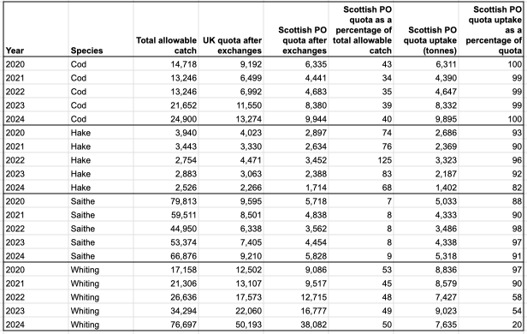
Table 1: Total allowable catches, UK and Scottish quota and uptake for the North Sea 2020 to 2024, Scottish Sea Fisheries Statistics 2020- 2024
Live - Next review due 15/01/2027
To report errors, highlight new data, or discuss alternative interpretations, please complete the form below and we will aim to respond to you within 28 days
Telephone: 07971149117
E-mail: ian.hay@stateofthecoast.scot
We need your consent to load the translations
We use a third-party service to translate the website content that may collect data about your activity. Please review the details in the privacy policy and accept the service to view the translations.