
East Grampian Coastal Partnership
www.stateofthecoast.scot
East Grampian Coastal Partnership
www.stateofthecoast.scot
Continued fluctuations in fish landings and their value at Scotland’s smaller harbours can have a disproportionate impact on small coastal communities. Although national statistics tend to focus on trends at major ports, variable catches at smaller harbours can create uncertainty and make long-term planning more difficult at the local level.
Smaller fishing ports along the north-east coast of Scotland, such as Cairnbulg, Boddam, Port Errol, Colliestone, Cove, Stonehaven, Gourdon, and Johnshaven, face significant infrastructure and maintenance challenges (Figure 1). Many of these harbours were established historically to serve local inshore fleets and are tidal facilities where boats may ground at low water, limiting their usability compared with deeper-water ports like Peterhead or Fraserburgh. Small harbour walls, quaysides, and ancillary structures are often in need of repair or modernisation to cope with current needs, but limited funding and coordination make this difficult. National reviews of marine sectors note that smaller harbours and marinas frequently lack the capital and support needed for adequate port infrastructure, which constrains their growth potential and long-term sustainability (Scottish Government, 2020).
These maintenance pressures are compounded by the fact that investment tends to concentrate around larger strategic ports, leaving smaller harbours less resourced. For example, Aberdeenshire Council has recently allocated funds to improve facilities at larger sites like Stonehaven and Macduff, addressing pier defects and other issues, but smaller trusts often receive only sporadic support (Aberdeenshire Council, 2024). This is typical across Scotland, where harbour infrastructure increasingly requires refurbishment due to age and wear, yet small ports struggle to attract sufficient funding to undertake essential repairs.
Smaller fishing ports also face economic pressures due to shifts in fish landings and the consolidation of fleets at larger harbours. The dominance of large ports such as Peterhead and Fraserburgh in landing volume and value has left many minor harbours with declining activity, forcing some to diversify or focus on recreational and heritage use rather than commercial fishing. As noted in regional strategy documents, many smaller harbours now support only a small inshore fleet, and communities facing a decline in fisheries-related landings must diversify infrastructure and local economies in response to changing circumstances (North Aberdeenshire Local Development Strategy, 2024). Many harbours in smaller communities have a major role in shorline protection, however they do not have a steady funding stream for when repairs and maintenance is needed.
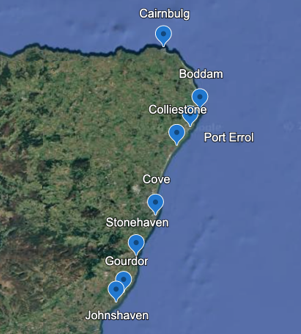
Figure 1: Small/ community harbour locations on the Grampian Coast, Google Earth, 2025
Live - Next review due 15/01/2026
To report errors, highlight new data, or discuss alternative interpretations, please complete the form below and we will aim to respond to you within 28 days
Telephone: 07971149117
E-mail: ian.hay@stateofthecoast.scot
We need your consent to load the translations
We use a third-party service to translate the website content that may collect data about your activity. Please review the details in the privacy policy and accept the service to view the translations.