www.stateofthecoast.scot
www.stateofthecoast.scot
Pressures/ regulations on greenhouse gas emissions
The maritime industry is a significant contributor to greenhouse gas emissions in Scotland and the UK, shaping both environmental pressures and regulatory responses that influence coastal regions such as Aberdeenshire and the broader East Grampian area. National data indicate that shipping accounted for around 14 % of Scotland’s transport greenhouse gas emissions in 2023, with projections suggesting that, even as other transport sectors decarbonise, shipping’s share may grow to about 20 % of Scottish transport emissions by 2035 without robust mitigation measures (Scottish Government, 2025) (Figure 1). Although this is Scotland-wide, it is directly relevant to the East Grampian maritime economy, given the heavy use of ports such as Aberdeen for commercial shipping, supply vessels and offshore support operations in the North Sea.
At the Port of Aberdeen, a major maritime hub in the East Grampian region, efforts to quantify and reduce emissions reflect both the scale of the challenge and the direction of regulatory pressure. A 2019 emissions baseline estimated the port’s overall footprint at approximately 44,000 tonnes of CO₂-equivalent, with around 97 % of that figure attributable to vessel arrivals, underscoring how ship activity, rather than port infrastructure itself, drives the majority of emissions (Port of Aberdeen, 2024). More recent reporting suggests that total emissions associated with the port (including client vessels and wider operations) amounted to around 70,919 tonnes CO₂-equivalent in 2023, with nearly 99 % generated by client vessels, highlighting the ongoing reliance on marine fuels and the need for decarbonisation strategies tailored to shipping operations (Port of Aberdeen, 2025).
Regulatory pressures at national and international levels are increasingly shaping how maritime emissions are addressed. The Scottish Government, working with the UK, supports International Maritime Organization (IMO) Net-Zero Framework negotiations, aiming for mandatory global measures to cut shipping greenhouse gas emissions by 80 % by 2040 and achieve net-zero around 2050. This is including fuel efficiency standards, emissions pricing mechanisms, and a dedicated Net-Zero Fund to support clean technologies (Scottish Government, 2025). Such frameworks are crucial for local operations in regions like East Grampian, as they set expectations for fleets, port authorities, and related supply chains.
At the regional scale, innovation and regulatory compliance are intersecting with infrastructure investment. Aberdeen is home to Scotland’s largest green shore power project, an initiative featuring shore power connections at eight berths that allow vessels to plug into low-carbon electricity while docked. This infrastructure is expected to reduce up to 60,000 tonnes of CO₂ equivalent over the next 20 years, equivalent to removing thousands of passenger vehicles from the road annually, and supports the port’s ambition to become the first net zero port in the UK by 2040 in line with emerging policy expectations (Port of Aberdeen, 2025).
Overall, the maritime industry in the East Grampian region is facing both environmental pressure to reduce greenhouse gas emissions and regulatory momentum aimed at driving decarbonisation. While shipping remains a substantial source of emissions, evolving frameworks such as IMO decarbonisation measures, national climate targets, and local initiatives like shore power demonstrate the increasing regulation and mitigation efforts underway to support cleaner maritime operations and limit long-term impacts on coastal ecosystems and climate systems.
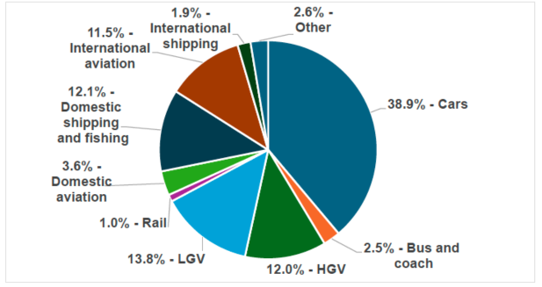
Figure 1: Mode share of all transport emissions, 2023, Scottish Government
13/01/2025 by Corinne Meinert
24/01/2026 by Mariia Topol
Not Live - Next review due 24/01/2027
To report errors, highlight new data, or discuss alternative interpretations, please complete the form below and we will aim to respond to you within 28 days
Telephone: 07971149117
E-mail: ian.hay@stateofthecoast.scot
We need your consent to load the translations
We use a third-party service to translate the website content that may collect data about your activity. Please review the details in the privacy policy and accept the service to view the translations.