
www.stateofthecoast.scot
www.stateofthecoast.scot
Pressures on employment
The maritime and fisheries sectors play a substantial role in employment across the East Grampian region, though they face pressures from economic change, regulatory shifts, and broader sector trends. According to Scotland’s Marine Economic Statistics 2022, fishing employed 4,117 people across Scotland, representing about 6% of total marine economy employment, with Aberdeenshire alone contributing £176 million in fishing gross value added (aGVA), roughly 52 % of the national total, highlighting the concentration of fishing jobs in the region’s ports such as Peterhead and Fraserburgh (Scotland's Marine Economic Statistics, 2022).
Within coastal communities specifically, older regional analysis indicates that the East Grampian area accounted for approximately 5,125 jobs in fishing and fish processing, and that fishing-related employment represented 2.7% of all jobs in the East Grampian coastal partnership area in 2021, compared with 0.2% nationally, reflecting the disproportionate socio-economic importance of the sector locally. While these figures include both direct and processing roles, they underscore how communities such as Fraserburgh, Peterhead, and Aberdeen are heavily reliant on marine industry jobs, particularly in whitefish landing, processing, gear services, and related supply chains.
Despite this regional significance, employment in the sector is not immune to wider pressures. National figures show that the total number of people employed in Scottish commercial fishing declined from 2013 to 2022, with employment falling by around 9% over that period even as fishing aGVA increased by 45% (Scotland's Marine Economic Statistics 2022, 2024). Historic region-specific data also indicated that in 2011, there were 1,608 fishermen employed in the North East SORER districts (Fraserburgh, Peterhead, Aberdeen), with 789 in Fraserburgh and 424 in Peterhead, and in areas like Fraserburgh, over 15% of total employment was directly involved in the fishing sector at that time (Scottish Governemnt, 2012).
Other maritime employment pressures in the region stem from shifts in the offshore energy and port sectors. Aberdeen Harbour historically supported significant employment related to broader maritime activity. Past estimates placed around 9,565 jobs for Aberdeen City and Aberdeenshire economies linked directly to harbour operations as of 2015, illustrating how port activity underpins local jobs beyond fishing. However, recent reporting suggests that downturns in North Sea offshore energy work, including slower than expected deployment of offshore wind support and declines in oil and gas activity, have led to workforce reductions and under-utilisation of expanded port capacity, highlighting vulnerability in maritime support services and associated employment (Aberdeen Harbour Expansion Report, 2015).
Overall, maritime employment in coastal Aberdeenshire and East Grampian remains a critical source of regional jobs, particularly in fishing and port-related sectors, but it is subject to pressures from industry decline, technological change, and economic restructuring. These employment trends carry significant implications for coastal communities dependent on maritime work, especially where alternative job opportunities may be limited or contingent on the success of emerging sectors like offshore renewables.
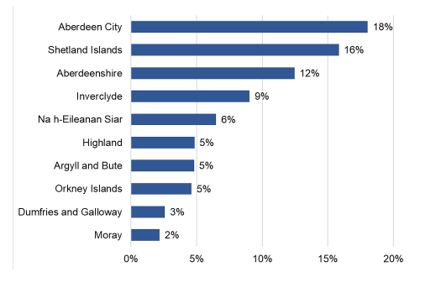
Figure 1: Percentage of approximate Gross Value Added accounted for by the marine sector for the top 10 local authorities, 2022, Scottish Government
13/01/2025 by Corinne Meinert
25/01/2026 by Mariia Topol
Not Live - Next review due 25/01/2027
To report errors, highlight new data, or discuss alternative interpretations, please complete the form below and we will aim to respond to you within 28 days
Telephone: 07971149117
E-mail: ian.hay@stateofthecoast.scot
We need your consent to load the translations
We use a third-party service to translate the website content that may collect data about your activity. Please review the details in the privacy policy and accept the service to view the translations.