www.stateofthecoast.scot
www.stateofthecoast.scot
Pressures on protected site condition and management
Protected features sites along the East Grampian coast, including designated Sites of Special Scientific Interest (SSSIs), Special Protection Areas (SPAs), and Special Areas of Conservation (SACs), are key to safeguarding habitats and species of international, national, and regional importance. For example, the Ythan Estuary and Sands of Forvie protects breeding populations of terns such as little tern (Sternula albifrons) and sandwich tern (Thalasseus sandvicensis) alongside significant estuarine habitats that support other waterfowl and intertidal communities (Scottish Government, 2020). The adjoining Sands of Forvie SAC covers over 735 ha of coastal sand dunes and associated habitats that host vegetation and geomorphological features of European interest (JNCC, 2020).
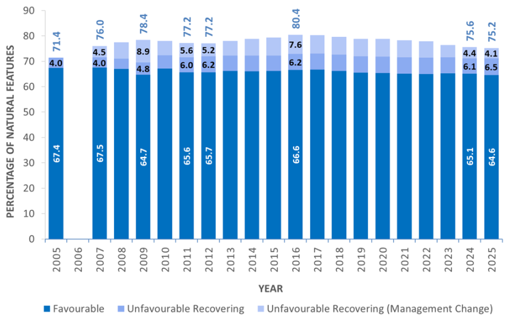
Despite strong legal designation, pressures on the condition of these protected sites persist and can compromise their biodiversity value. National statistics on protected nature features published by NatureScot indicate that, as of March 2025, 75.2 % of assessed natural features on protected sites in Scotland are in favourable or recovering condition, with the remainder in unfavourable condition or declining (Figure 1). While this figure shows a long-term improvement, it also underscores that roughly 24.8 % of features remain in less than ideal condition, suggesting ongoing pressures. These conditions can reflect challenges such as disturbance to sensitive bird nesting sites, changes in hydrology or sediment dynamics, and the spread of invasive species, all of which require active management to address.
Evidence from Aberdeenshire planning documents confirms that coastal protected areas can experience pressures associated with development and recreational use. For example, historical assessments note that new development has the potential to put pressure on protected sites including stretches of the Ythan Estuary and Sands of Forvie SSSI. Additionally, condition assessments of some terrestrial features (e.g., at Troup Head and other coastal sites) have been classed as unfavourable or mixed in quality (Aberdeenshire Council, 2023). This highlights the ongoing need for careful management to ensure that conservation objectives are met, especially in sites that combine high biodiversity value with visitor use and settlement proximity.
None
07/01/2026 by Corinne Meinert
17/01/2026 by Mariia Topol
Not Live - Next review due 17/01/2027
To report errors, highlight new data, or discuss alternative interpretations, please complete the form below and we will aim to respond to you within 28 days
Telephone: 07971149117
E-mail: ian.hay@stateofthecoast.scot
We need your consent to load the translations
We use a third-party service to translate the website content that may collect data about your activity. Please review the details in the privacy policy and accept the service to view the translations.