www.stateofthecoast.scot
www.stateofthecoast.scot
Pressures from invasive/non-native species
Coastal and marine ecosystems in the East Grampian region face rising pressure from invasive and non-native species (INNS), which can harm native biodiversity by out-competing indigenous species, altering habitats, and disrupting ecological networks. Across Great Britain, of the 3,343 non-native species recorded, about 2,074 are established in the wild, and approximately 195 non-native species are considered invasive because they adversely affect native biodiversity, including around 40 marine species found along the coastline and estuaries (JNCC, 2025). These figures reflect a long-term increase in INNS in coastal environments, a trend that increases pressure on native species and habitats in regions like northeast Scotland.
In the marine and coastal context, several non-native species known to Scotland are relevant to the East Grampian region and have the potential to alter intertidal and subtidal communities. High-impact marine invaders documented in Scottish waters include species such as common cord-grass (Spartina anglica), which can transform sediment dynamics in estuaries and intertidal flats, and the carpet sea squirt (Didemnum vexillum) and leathery sea squirt (Styela clava), can overgrow native sessile organisms such as mussels and other invertebrates, reducing space and resources for native species. Although specific local abundance data for Aberdeenshire waters are limited, these species are recognised across Scotland as having significant adverse effects on biodiversity where they are present (Marine Scotland Assesment, 2022).
On the terrestrial margins of the coastal environment, such as dunes, river estuaries, and brackish wetlands that interface with the sea, invasive plant species also pose a serious threat to native biodiversity. Common problematic invaders across Scotland include Japanese knotweed (Fallopia japonica), giant hogweed (Heracleum mantegazzianum), Himalayan balsam (Impatiens glandulifera) and American skunk cabbage (Lysichiton americanus), all of which are present in Aberdeenshire and can dominate ground cover, displacing native vegetation and altering habitat structure. Aberdeenshire Council specifically lists these species among those that can be reported and managed due to their ecological and physical impacts on land and riparian corridors connected to coastal system (Aberdeenshire Council, 2025).
The ecological consequences of INNS in coastal regions include reduced native species richness, altered food webs, and habitat modification, which can cascade through coastal ecosystems and affect the species that depend on them, from invertebrates and seaweeds, to birds and fish that use estuaries and nearshore zones for feeding and breeding. Because many INNS are difficult to eradicate once established, early detection and monitoring, such as the Scottish Invasive Species Initiative covering parts of Aberdeenshire, are crucial to prevent further spread and protect biodiversity in coastal and inland waters (https://invasivespecies.scot/).
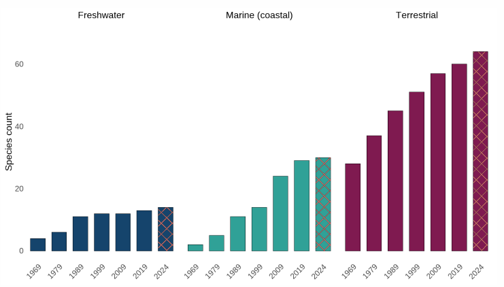
Figure 1: Cumulative net total number of invasive non-native species established across or along 10% or more of the land area or coastline of Great Britain, 1969 to 2023, Department for Environment Food and Rural Affairs
None
Defra.gov.uk. (2025). UKBI - Invasive species | Advisor to Government on Nature Conservation | JNCC
Scottish Government (2020). Non-native species | Scotland’s Marine Assessment 2020
Aberdeenshire Council (2026). Report invasive plants - Aberdeenshire Council
Scottish Government (2019). Scottish invasive species initiative | Scotland’s environment web
07/01/2026 by Corinne Meinert
13/01/2026 by Mariia Topol
Not Live - Next review due 06/01/2027
To report errors, highlight new data, or discuss alternative interpretations, please complete the form below and we will aim to respond to you within 28 days
Telephone: 07971149117
E-mail: ian.hay@stateofthecoast.scot
We need your consent to load the translations
We use a third-party service to translate the website content that may collect data about your activity. Please review the details in the privacy policy and accept the service to view the translations.