www.stateofthecoast.scot
www.stateofthecoast.scot
Pressures from land/ water management practices
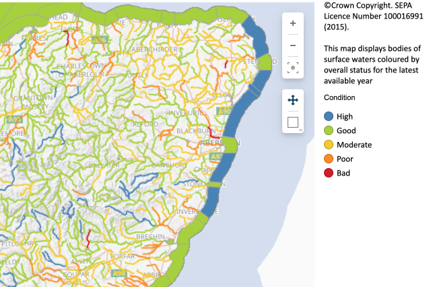
Coastal and near-coastal land and water management practices can cause continual pressure on biodiversity in East Grampian by altering habitat quality and hydrological processes. Agricultural runoff, including fertilisers, pesticides, and slurry from fields, is a widespread source of nutrient and chemical input into waterways that flow into estuaries and the sea, contributing to degraded water quality that can harm coastal habitats. Scottish Environment Protection Agency (SEPA) data show that agricultural and forestry runoff has led to 363 rivers, lochs, canals, burns, estuaries, coastal areas and groundwater bodies being downgraded in status, placing aquatic plants and animals at risk. This indicates that diffuse pollution remains a significant stressor on coastal ecosystems in Scotland, including Aberdeenshire catchments feeding into the North Sea (SEPA, 2020). Among those with the worst water quality are the River Don in Aberdeenshire (Figure 1).
In addition to pollution pressures, water abstraction and altered flow regimes from land management and development can affect riparian and estuarine habitats that support diverse species. Local planning assessments note that water abstraction related to development can change water flows and impact habitats such as the River Dee, whose catchment influences the coastal region’s biodiversity by providing nursery and feeding grounds for fish and invertebrates (Aberdeenshire Council, 2023).These flow changes can also reduce freshwater inputs to estuaries, altering salinity gradients and organic matter transport, which are important drivers of productivity for species at the interface of terrestrial and marine systems.
Coastal saltmarshes and dunes, which provide critical habitat for birds and specialised plant communities, are vulnerable to changes in land use and management practices on adjacent land. Although specific local figures for East Grampian's saltmarsh loss are not routinely published, UK-wide estimates suggest saltmarshes have declined by approximately 15 % since 1945, with ongoing susceptibility to erosion and land management impacts such as trampling or livestock grazing that can compact soils and reduce vegetation diversity (FAS, 2023). Saltmarshes also rely on balanced sediment dynamics and water quality, excessive sedimentation or nutrient enrichment from land use can shift plant community composition and reduce habitat complexity that supports invertebrates and birds.
Intensification of agriculture and changes in grazing practices across East Grampian’s coastal land contribute to biodiversity pressures by homogenising habitats and reducing structural diversity that supports wildlife. Broader Scottish data indicate that species abundance has fallen by about 15 % since 1994, and nearly 11 % of the UK’s roughly 7,508 species are classified as threatened with extinction, partly reflecting long-term land management impacts such as nutrient enrichment, soil compaction, and changes in habitat connectivity (Scottish Governemnt, 2025). These patterns are also reflected in local coastal landscapes, where the interface between farmland and natural habitats influences wildlife communities and impacts the resilience of coastal ecosystems.
None
07/01/2026 by Corinne Meinert
17/01/2026 by Mariia Topol
Not Live - Next review due 17/01/2027
To report errors, highlight new data, or discuss alternative interpretations, please complete the form below and we will aim to respond to you within 28 days
Telephone: 07971149117
E-mail: ian.hay@stateofthecoast.scot
We need your consent to load the translations
We use a third-party service to translate the website content that may collect data about your activity. Please review the details in the privacy policy and accept the service to view the translations.